- PDCA Cycle: A Model for Learning and Improvement
- Lean: Maximize Value, Minimize Waste
- BABOK: Business Analysis and PDCA
- PMBOK: Project Management Through PDCA
- Agile: A Flexible Approach to Software Development
- PACE: A Framework for Data Science Projects
- Design & Build a House: A Practical Model
- SPAR: Sense, Plan, Act, Reflect
- SPAR: Understanding AI Agents
In our PDCA series we have looked at project management (PMBOK) as one way the cycle scales to large initiatives. Another is BABOK—the Business Analysis Body of Knowledge from the International Institute of Business Analysis (IIBA). BABOK focuses on understanding business needs, defining requirements, and guiding solutions to deliver value. Like other frameworks, it can be mapped back to PDCA. We have other business analysis post here at this site. One is called Overview of the BABOK Framework.
The Six Knowledge Areas of BABOK
BABOK groups business analysis work into six areas:
- Business Analysis Planning & Monitoring: Planning the approach, stakeholders, and governance of analysis work.
- Elicitation & Collaboration: Working with stakeholders to gather and clarify needs.
- Requirements Life Cycle Management: Managing requirements as they evolve throughout a project.
- Strategy Analysis: Defining business needs, assessing capabilities, and recommending strategies.
- Requirements Analysis & Design Definition: Breaking down needs into requirements and proposing solutions.
- Solution Evaluation: Assessing how well a solution delivers value and recommending improvements.
BABOK Compared to PDCA
Mapping BABOK to PDCA reveals a familiar pattern:
- Plan: Strategy Analysis and Business Analysis Planning
- Do: Elicitation, Collaboration, and Requirements Analysis & Design
- Check: Solution Evaluation
- Act: Recommendations and improvements from Solution Evaluation feed back into the next cycle
This shows how business analysis is not a one-time effort but an ongoing cycle of planning, doing, checking, and adapting.
Why BABOK Matters
Where PMBOK ensures projects are managed effectively, BABOK ensures that the right solutions are being built. It centers on understanding business needs, engaging stakeholders, and delivering value. When viewed through PDCA, BABOK highlights the importance of analysis and learning as essential parts of continuous improvement.
An Example of BABOK in Action
Imagine a bank that wants to introduce mobile check deposits. Analysts begin with Strategy Analysis and Planning. They then Elicit requirements from customers and staff, and Analyze & Design the app features. After building the solution, they Evaluate its performance, gathering feedback and recommending refinements. This cycle echoes PDCA and demonstrates how BABOK guides real-world change.
BABOK Techniques and Tools
BABOK v3 lists 50 techniques — everything from brainstorming and SWOT to use cases, process modeling, prototyping, data flow diagrams, and surveys. They aren’t tied to a single step; instead, they’re reusable methods that support different knowledge areas.
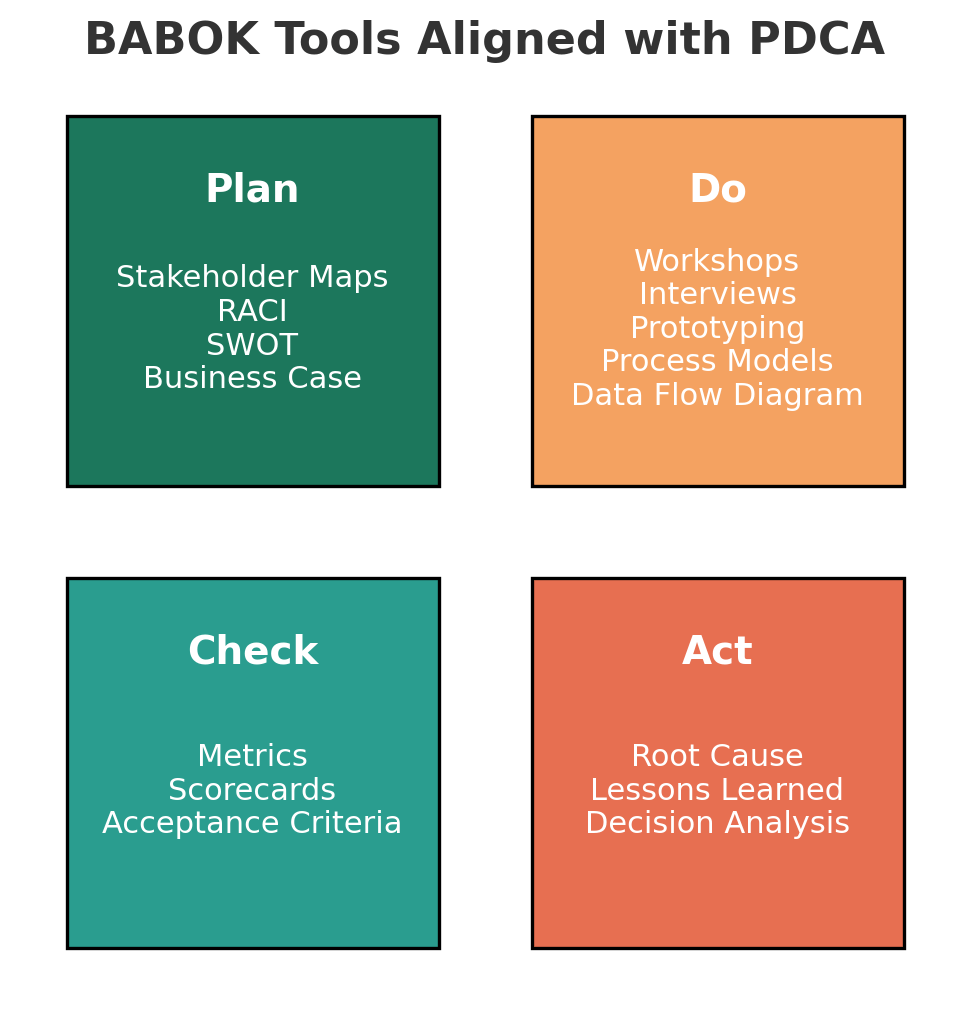
One of the strengths of the BABOK framework is its extensive collection of techniques — practical tools that analysts can use at different stages of the cycle. When we align them to PDCA, we see how they support each phase:
- Plan: Techniques such as Stakeholder Lists and Maps, RACI matrices (who is Responsible, Accountable, Consulted, Informed), SWOT analysis (strengths, weaknesses, opportunities, threats), and Business Cases help teams define the problem, understand stakeholders, and set a clear direction.
- Do: Tools like Workshops, Interviews, Prototyping, Process Modeling, and Use Cases and Data Flow Diagrams support the design and development of solutions. They help capture requirements, validate ideas, and bring clarity to how a solution should work.
- Check: Techniques such as Metrics, Balanced Scorecards, and Acceptance and Evaluation Criteria allow analysts to assess whether the solution is delivering the intended value.
- Act: Tools like Root Cause Analysis, Lessons Learned, and Decision Analysis provide the foundation for adapting solutions and improving future projects.
This toolbox shows how BABOK not only describes the cycle of analysis but also equips practitioners with methods to make each step more effective. It reinforces the link between PDCA and business analysis: improvement is both a cycle and a toolkit.
Closing Thoughts
BABOK reinforces the universality of PDCA. It frames analysis as a cycle of planning, acting, and reflecting—ensuring that solutions truly meet business needs. Adding BABOK to our series connects the dots between improvement, projects, and analysis, showing how each discipline contributes to smarter, more effective change.