- PDCA Cycle: A Model for Learning and Improvement
- Lean: Maximize Value, Minimize Waste
- BABOK: Business Analysis and PDCA
- PMBOK: Project Management Through PDCA
- Agile: A Flexible Approach to Software Development
- PACE: A Framework for Data Science Projects
- Design & Build a House: A Practical Model
- SPAR: Sense, Plan, Act, Reflect
- SPAR: Understanding AI Agents
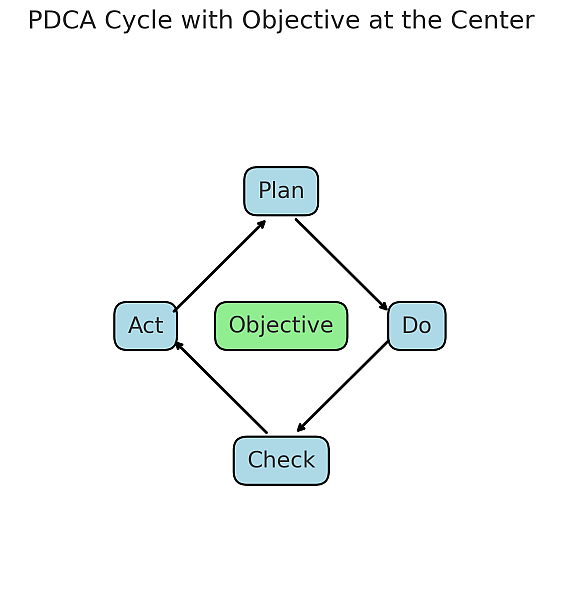
Artificial intelligence, business, education, and even everyday life all share a common truth: progress happens in cycles. One of the simplest and most powerful cycles is PDCA — Plan, Do, Check, Act. There are many places in life where this simple model can be used. In the diagram you’ll see that the arrows go only one way. In reality, they can go both ways as you always are in a state of growth and adjustment as you aim for continuous improvement. Growing and improving are part of the Agile and growth mindset, as mentioned below. The model looks like this:
- Plan – Decide what you want to achieve and how you’ll try.
- Do – Take action, often starting small.
- Check – Evaluate what happened. Did things go the way you hoped?
- Act – Adjust based on what you’ve learned, then begin again.
The Often-Missed Step: What Is the Objective?
Often, this step is not entirely missed, but too often it has not been thought through enough. Before rushing into action, we need to pause and ask: What is the objective? We often want to see the results of our efforts quickly, and we lack patience. That’s understandable. Spend time on the planning stage. Both the PMBOK and the BABOK mention this. What happens if we don’t spend some time thinking about the objective?
- In business, skipping this step leads to wasted projects.
- In personal growth, it leads to chasing someone else’s definition of success.
- In AI, unclear objectives mean models are trained on the wrong tasks.
- In project management, this is the first phase: Project Initiating
Growth Mindset in the Cycle
Carol Dweck’s concept of growth mindset reminds us that results don’t define us. Instead of aiming for a perfect “score,” we treat each cycle as a chance to learn.
- Check is not about judgment. It’s about feedback.
- Imperfect results aren’t failures — they’re fuel for improvement.
- This mindset keeps us curious, persistent, and open to growth.
Even AI models follow this pattern. When an AI “hallucinates,” it doesn’t mean AI is useless — it means the system needs more training, better feedback, or clearer objectives. The same applies to us as learners and creators.
Agile and Continuous Improvement
If PDCA feels familiar, it’s because variations of it show up everywhere:
- Agile uses short “sprints” with planning, building, testing, and reviewing.
- PACE (Plan, Analyze, Construct, Execute) reframes the steps for data teams at Google.
- Education often uses Plan, Do, Evaluate, Adjust — more student-friendly wording.
PDCA is not about being perfect. It’s about iterating toward better outcomes.
Related Posts in this Series
- PDCA Cycle – A model for learning and improvement (this post)
- Lean – Maximizing value and minimizing waste
- Agile – Iterative development and adaptability
- PACE – A framework for data science projects
- AI Framework – Emerging approaches for intelligent systems