- PDCA Cycle: A Model for Learning and Improvement
- Lean: Maximize Value, Minimize Waste
- BABOK: Business Analysis and PDCA
- PMBOK: Project Management Through PDCA
- Agile: A Flexible Approach to Software Development
- PACE: A Framework for Data Science Projects
- Design & Build a House: A Practical Model
- SPAR: Sense, Plan, Act, Reflect
- SPAR: Understanding AI Agents
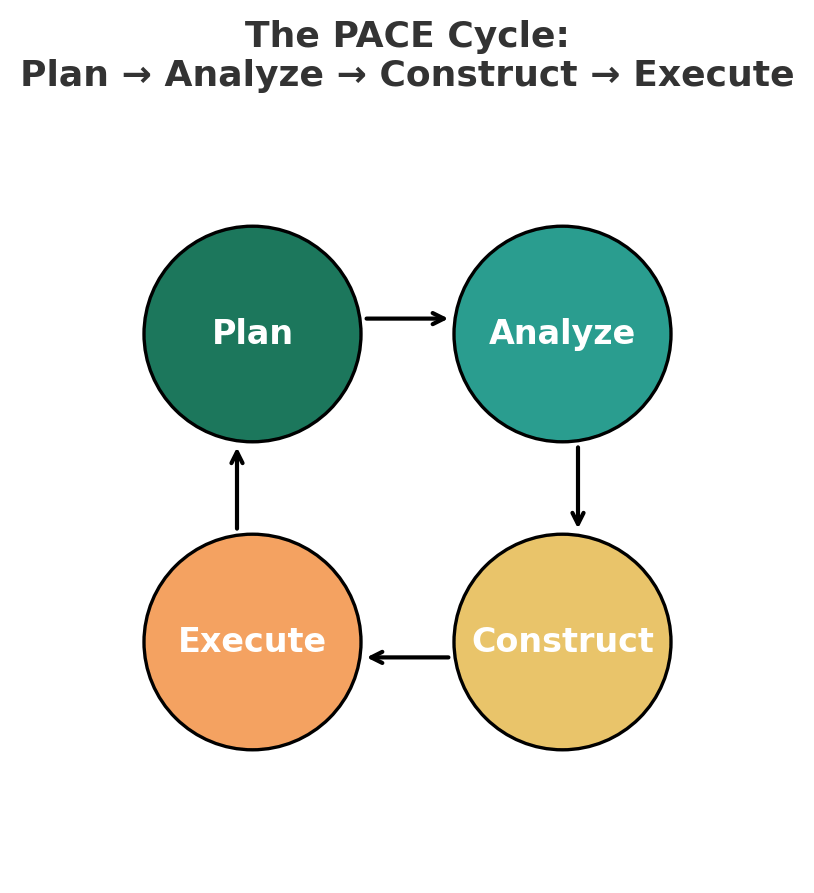
In our Plan-Do-Check-Act (PDCA) series, we started with PDCA as a general improvement cycle, then explored Lean for business and Agile for software development. Now we turn to PACE—a framework designed specifically for data science and analytics projects.
You will notice that the PACE framework adds more steps to the second step, Do, of the PDCA framework. This reflects the complexity of data science.
What Is PACE?
PACE stands for Plan – Analyze – Construct – Execute. It takes the PDCA model and expands the “Do” phase into three detailed steps. This reflects the complexity of data science projects, where analysis, modeling, and implementation require more structure than a single “Do.”
The Four Steps of PACE
- Plan: Define the problem, scope the project, gather requirements, and identify the data you’ll need.
- Analyze: Explore the data, clean it, and apply statistical or machine learning methods to uncover insights.
- Construct: Build models, validate them, and create solutions that can be applied to real-world decisions.
- Execute: Deploy the model or solution, integrate it into workflows, and communicate results to stakeholders.
By breaking the process into these steps, PACE helps teams move methodically from raw data to actionable insights.
Why PACE Matters
Data science is inherently iterative. Analysts often revisit earlier steps as new questions arise or as data reveals unexpected patterns. PACE provides a roadmap while still allowing for flexibility and backtracking. It ensures that projects don’t jump from raw data to conclusions without proper planning and validation.
PACE Compared to PDCA, Lean, and Agile
PACE builds on the foundation of PDCA but zooms in on the “Do” stage, giving more detail where data projects demand it. Like Lean, it emphasizes delivering value and avoiding wasted effort. Like Agile, it encourages iteration and responsiveness to change. But its focus is unique: guiding teams through the lifecycle of data-driven work.
An Example of PACE in Action
Imagine a healthcare team exploring patient data to reduce hospital readmissions. They start with Plan by identifying the problem and gathering patient records. In Analyze, they clean the data and run statistical tests. During Construct, they build a predictive model to identify at-risk patients. Finally, they Execute by deploying the model into hospital systems so doctors can make better decisions.
Closing Thoughts
PACE is the data science chapter in our PDCA journey. By expanding “Do” into Analyze, Construct, and Execute, it provides a structured approach for tackling complex, data-driven projects. It also serves as a bridge toward the future—where artificial intelligence will demand even more refined cycles of learning and improvement.