- PDCA Cycle: A Model for Learning and Improvement
- Lean: Maximize Value, Minimize Waste
- BABOK: Business Analysis and PDCA
- PMBOK: Project Management Through PDCA
- Agile: A Flexible Approach to Software Development
- PACE: A Framework for Data Science Projects
- Design & Build a House: A Practical Model
- SPAR: Sense, Plan, Act, Reflect
- SPAR: Understanding AI Agents
This model blends industry phases with continuous feedback. Think PDCA at the macro level, Lean for schedules and waste reduction, and Agile-style feedback during design. The PDCA model is great, however when the complexity of projects increases we may need to add more steps, particularly in the first stage of PDCA, Plan. First though, here is a bit of construction background information:
- AIA = American Institute of Architects — the main professional body for architects in the United States. It publishes standard contract forms and defines common project phases (Programming → Schematic Design → Design Development → Construction Documents → Bidding/Negotiation → Construction Administration → Closeout).
- RIBA = Royal Institute of British Architects — the UK counterpart. It publishes the RIBA Plan of Work, a stage-by-stage framework (from Strategic Definition through Handover and Use) used widely across architecture and construction.
1) Discover (Needs & Budget)
Clarify goals, lifestyle needs, must-haves/nice-to-haves, ballpark budget, financing. Collect inspiration. Establish decision-makers and communication cadence.
2) Site & Codes (Feasibility)
Assess site conditions (orientation, grade, services), zoning/bylaws, setbacks, conservation rules. Early energy/solar potential checks. Update budget realism.
3) Concept Design (Options + Feedback)
Create 2–3 layout/massing options. Iterate quickly with homeowner feedback (short cycles). Identify trade-offs (area vs. cost, glazing vs. energy). Choose a direction.
4) Develop Design (Details & Performance)
Refine plans, elevations, structure, HVAC, insulation, windows/doors. Run basic energy and daylight checks. Start product/system selections. Update cost plan.
5) Documents & Approvals (Permit-Ready)
Produce drawings/specs for permits and pricing. Coordinate with structural, mechanical, and energy consultants. Submit for permit; address comments.
6) Price & Plan (Procurement & Schedule)
Tender to builders or negotiate with a selected design-build partner. Use Lean tools (pull planning, milestones, buffers). Lock scope, schedule, allowances, contract.
7) Build (Execute & Inspect)
Groundworks → structure → envelope → services → finishes. Weekly site meetings, visual boards, issue logs. Inspections at key stages. Keep change control strict.
8) Handover & Learn (Closeout)
Final inspections, occupancy, manuals, warranties, homeowner training. Post-occupancy check (3–12 months) to capture lessons for future improvements.
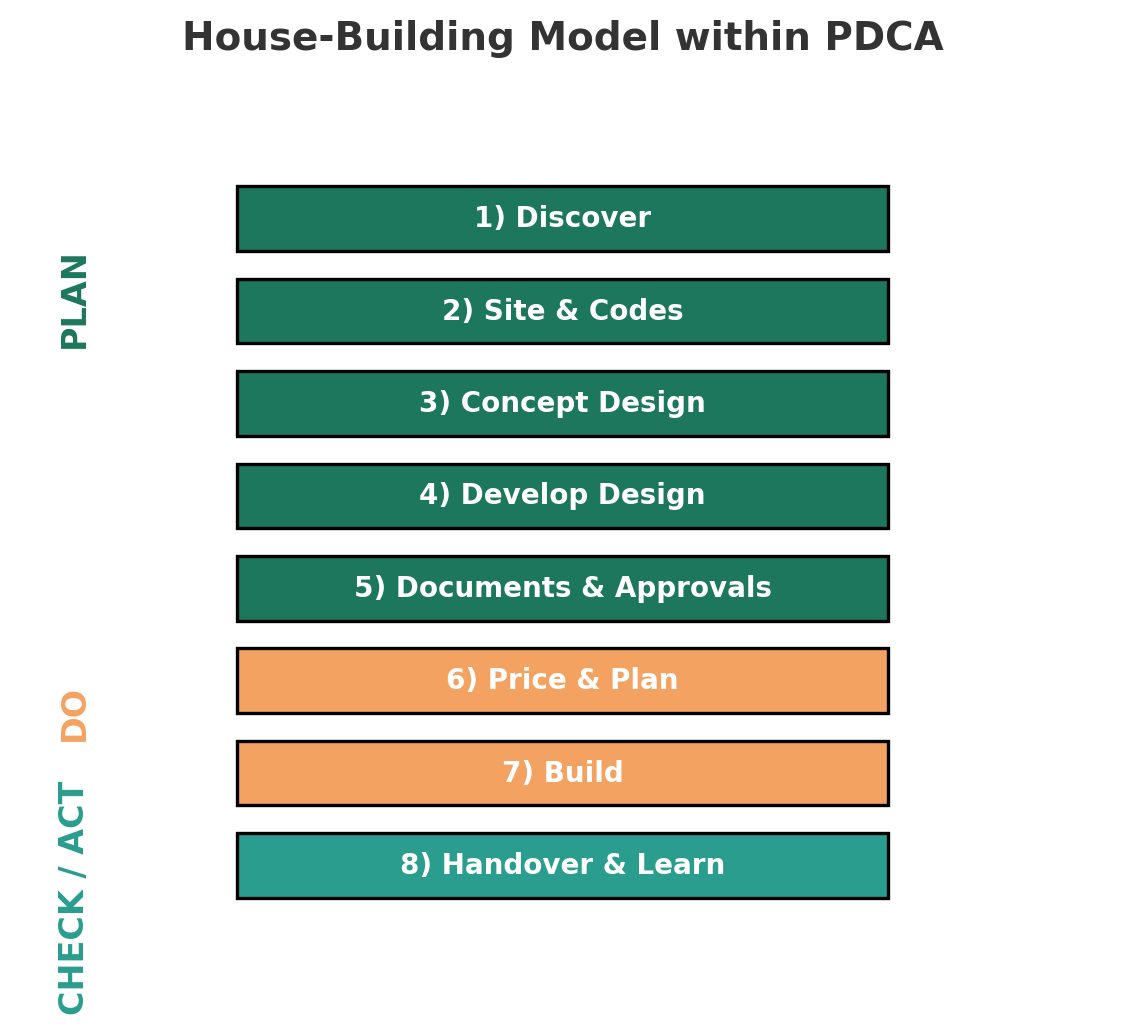
When we compare this house-building model to the classic PDCA cycle, it becomes clear that the Plan phase is far more extensive. Instead of a single step, it stretches across multiple stages: discovering needs, checking site feasibility, creating concept designs, developing details, and preparing documents and approvals. This expansion reflects the complexity of construction, where every choice must align with building codes, safety standards, and long-term performance. Unlike software, where iterations can be fast and low-risk, decisions in construction are difficult to reverse once the ground is broken. As a result, more time and rigor are invested upfront before moving into the Do phase.
Here’s how the house-building model looks when mapped into PDCA:
- Plan (green) stretches across the first 5 steps.
- Do (orange) covers steps 6–7.
- Check/Act (teal) is step 8.