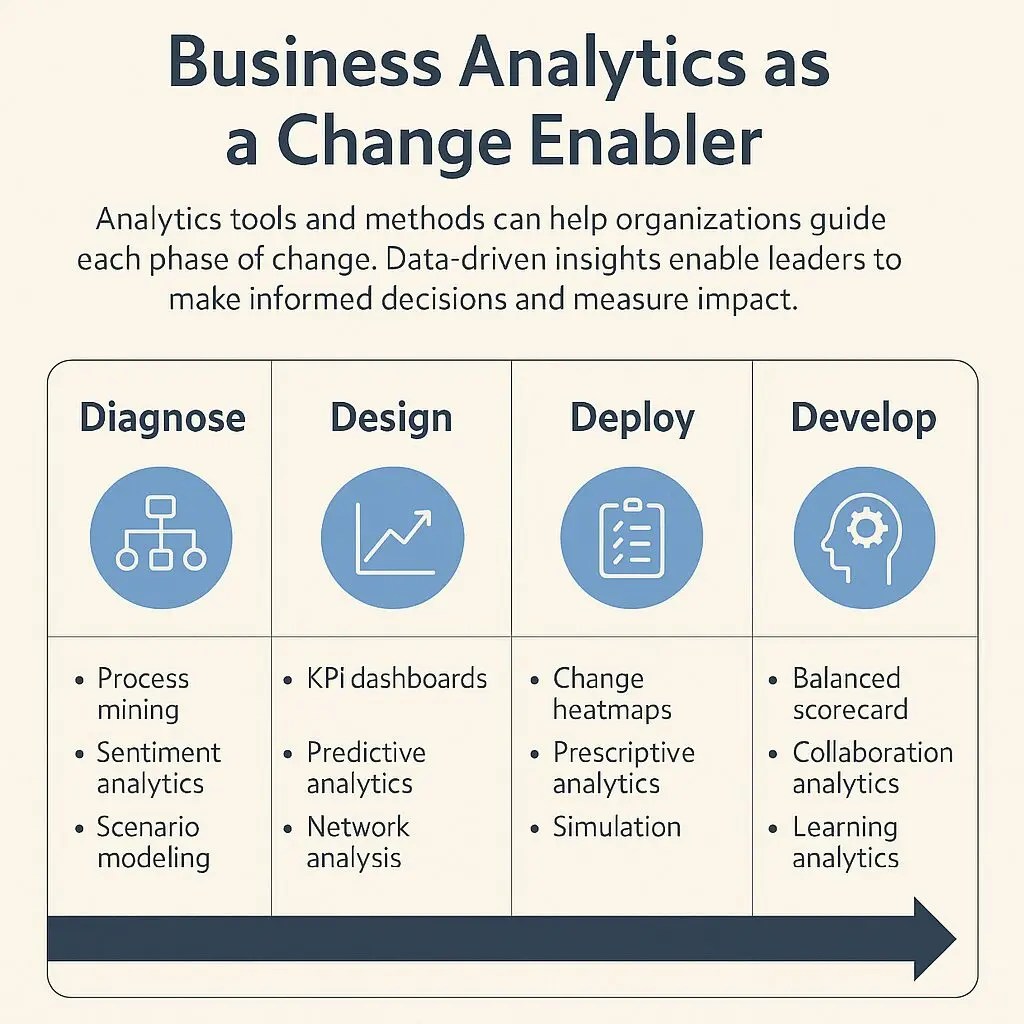
Business Analytics as a Change Enabler
When organizations begin integrating AI agents, Business Analytics provides the compass for navigating complexity. Analytics methods make it possible to measure readiness, monitor impact, and continuously refine both human and digital workflows. Rather than relying on guesswork, data-driven insight becomes the foundation for adaptive change management.
1. Process Mining and Workflow Analytics
Before automating or redesigning work, companies must understand how work actually flows. Process mining tools—such as Celonis, UiPath Process Mining, or Power BI process maps—use system logs to visualize real business processes in action.
- Identify bottlenecks, rework loops, and inefficiencies in current workflows.
- Compare “as-is” processes with proposed AI-enabled designs.
- Quantify where agentic automation can create the most value.
This analysis also supports transparency—employees can see that redesign decisions are based on evidence, not assumption.
2. Change Readiness and Sentiment Analytics
Change succeeds only when people support it. Employee sentiment analysis—using surveys, HR data, or text analytics—can gauge how the workforce feels about AI adoption.
- Use dashboards to track confidence, anxiety, and perceived fairness over time.
- Apply clustering or regression to find which departments or roles need extra communication or training.
- Combine qualitative feedback with quantitative indicators for a complete picture of readiness.
Some organizations integrate these insights into change heatmaps, showing where leadership should focus engagement efforts.
3. Balanced Scorecards and KPI Dashboards
The book’s emphasis on trust, empowerment, and learning can be supported by a Balanced Scorecard approach. Using tools like Power BI, Tableau, or Looker, leaders can visualize multi-dimensional performance data in real time.
- Operational metrics: process speed, accuracy, and cost per transaction.
- Employee metrics: training completion, skill growth, satisfaction scores.
- Customer metrics: response times, NPS, and service quality.
- Learning metrics: how agent performance improves through feedback loops.
Balanced dashboards help teams see progress on both human and technological fronts—turning transformation into a measurable journey.
4. Predictive and Prescriptive Analytics
Predictive modeling can forecast where adoption challenges or performance dips might occur (for example, using regression or machine learning on HR and operational data). Prescriptive analytics then recommends targeted actions to mitigate risk.
- Predict which functions are most ready for agentic automation.
- Model the J-curve of performance dips and recovery periods.
- Prescribe training or resource allocation strategies for smoother transitions.
These insights help leaders manage expectations and make proactive adjustments rather than reactive fixes.
5. Network and Collaboration Analytics
As AI agents reshape workflows, it becomes vital to understand how information and trust move through the organization. Organizational Network Analysis (ONA) maps relationships among employees and teams using communication or collaboration data.
- Identify “change champions” and informal influencers who can model agentic adoption.
- Detect silos that may slow cross-functional integration.
- Track how human–AI interaction patterns evolve over time.
Combining ONA with qualitative insights helps ensure that hybrid human–AI collaboration grows naturally within trusted networks.
6. Scenario Planning and Simulation
When leadership needs to anticipate the long-term impact of agentic transformation, scenario modeling and system dynamics simulations can visualize outcomes before implementation.
- Model workforce shifts, cost trajectories, and innovation payoffs.
- Test different governance or training investment levels.
- Use simulation dashboards to engage executives and employees in strategic dialogue.
This method helps align technology rollout with human development and strategic priorities.
7. Continuous Feedback and Learning Analytics
Finally, the transformation process itself becomes a source of learning. Learning analytics tools track how employees acquire and apply new skills related to AI collaboration.
- Analyze participation in sandbox or low-code experimentation programs.
- Measure how peer learning networks contribute to adoption success.
- Correlate learning engagement with business outcomes.
These insights close the feedback loop—ensuring that human development evolves alongside technological capability.
Summary: Data as the Thread of Transformation
In the end, Business Analytics is not a separate layer on top of agentic transformation—it is the thread that connects leadership vision, employee experience, and AI capability. When used thoughtfully, analytics tools make invisible change visible, helping organizations design, measure, and refine their human–AI ecosystems with clarity and trust.