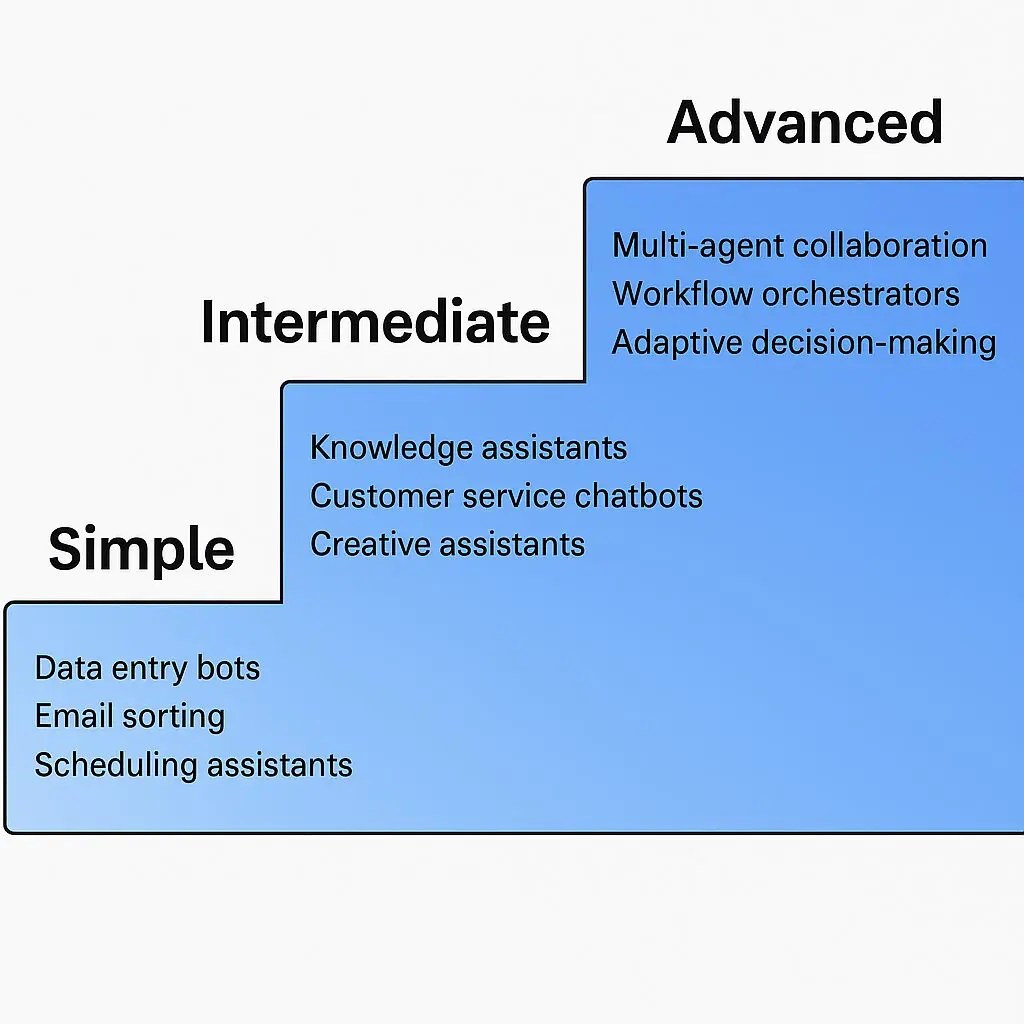
One of the clearest ways to identify where agentic AI can help is by looking at the types of tasks we or our organization perform every day. Instead of thinking about industries or business departments, we can simply ask: what kind of work is this? By categorizing tasks, it becomes easier to spot opportunities for AI agents to take over, assist, or accelerate.
Start Simple, Then Build
Pascal Bornet and other AI experts stress the importance of starting simple. Early wins with basic agentic AI use cases help teams build confidence quickly. Over time, as familiarity and trust grow, more complex opportunities can be tackled. This step-by-step approach avoids overwhelm and helps organizations adopt AI in a sustainable way.
Repetitive Tasks
- Data entry – automatically extract and input information from documents.
- Scheduling – book meetings or shifts by matching availability and rules.
- Reporting – generate standard weekly or monthly summaries without manual effort.
Repetitive tasks are the easiest entry point for agentic AI, since the rules are clear and the processes are predictable.
Knowledge Tasks
- Summarization – distill long reports, articles, or meeting transcripts into key points.
- Research assistants – gather relevant facts or data from multiple sources.
- Decision support – suggest next steps based on policies, past cases, or best practices.
Knowledge tasks benefit from agents that can process large volumes of information quickly and consistently.
Creative Tasks
- Content generation – draft blogs, ads, or social posts in different tones or styles.
- Design helpers – propose layouts, images, or prototypes for review.
- Idea expansion – brainstorm campaign slogans, new product names, or strategic options.
Creative tasks are less about rules and more about inspiration. AI agents can accelerate ideation and help teams explore options they might not have considered on their own.
Coordination Tasks
- Project management – track progress, assign tasks, and send reminders.
- Workflow orchestration – move data or documents between systems automatically.
- Collaboration agents – ensure communication across teams, summarizing discussions and aligning stakeholders.
Coordination tasks are where agentic AI begins to shine at a higher level, acting as an organizer that keeps people and systems working together smoothly.
Conclusion
By breaking down opportunities into task types, organizations can see a natural progression: start with repetitive, low-risk automations; expand into knowledge and creative assistance; and eventually move toward complex coordination across teams and systems. In today’s competitive world, beginning with simple agentic AI projects allows organizations to build trust and capability quickly, while positioning themselves to take on more ambitious opportunities in the future.